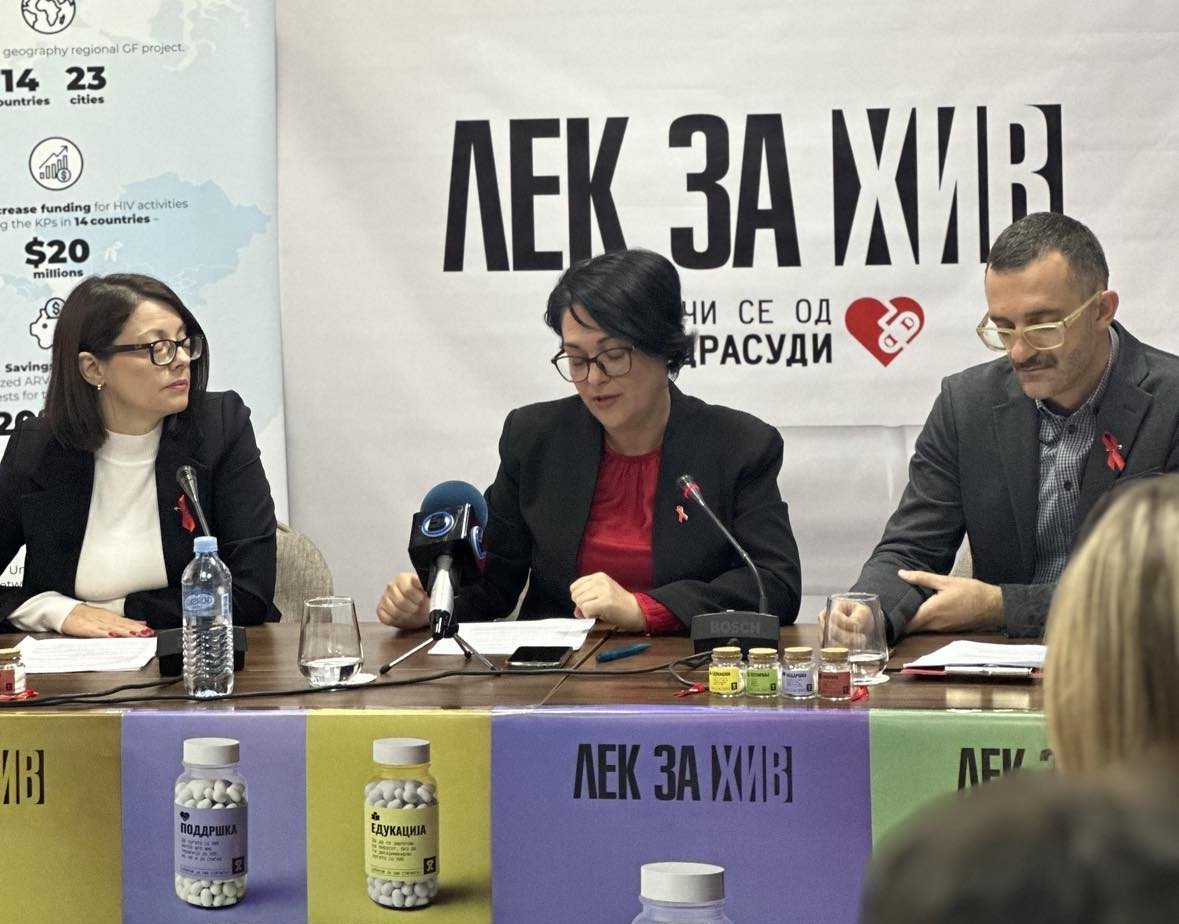
1st December 2023 – Even though the world today is talking about ending the HIV epidemic by 2030, the healthcare system in the Republic of North Macedonia has been failing to diagnose the people living with HIV, while the Government’s HIV Programme funds earmarked for prevention have been continuously reduced for three years in a row, representatives of the HIV Platform pointed out at a press conference held on the occasion of today’s World AIDS Day.
While the world has seen a significant drop in new HIV infections and an increasing number of people who are aware that they have the virus and who are receiving antiretroviral therapy, in our country, according to the latest estimates for 2021, there are about 500 people living with HIV, only 70% of which have been diagnosed. This is largely owing to the curtailed funding of the HIV Programme, which has consequently drastically reduced the HIV prevention activities, as well as their scope and quality.
As an illustration, the 2018 budget amounted to 95 million denars, when some 200 patients were undergoing treatment; the current planning, however, provides for an amount of 90 million denars in 2024, when more than 430 patients are expected to be treated. Therefore, we expect the Government to fulfil its promise to increase the prevention programmes’ budget by at least 10 million denars so as to maintain the prevention at a minimum level.
“If we invest more now in prevention and testing, we will detect more people who have the infection but are not aware of it, so instead of 45 infections a year, we could reach 60 or 70 new diagnoses a year over the next period. In the short term, this will require greater investment in therapy, as it will have to be secured for a larger number of people a year. However, already in the medium term, by 2030 we will have suppressed the epidemic, the number of new infections will have dropped significantly, and so will have the number of new diagnoses. At the same time, treatment costs will stabilise and gradually begin to decline. If the current trend persists, in 2030 we will still have a large number of new infections and deaths outcomes, and the costs of treatment will continue to grow indefinitely,” said Elizabeta Božinoska from the Association HERA.
We must not overlook the fact that the programmes implemented by civil society organisations in a dozen of cities across the country are, for some people, the only access to the most basic health care. These are the only public health measures to control syphilis and other sexually transmitted infections, because they allow for easy diagnosis and treatment, thus preventing the spread of sexually transmitted infections.
“HIV therapy, which is free and available in the country, is the key to suppressing the virus to an undetectable level, so that a person living with HIV can function normally, have excellent health status and live as long as people who do not have the HIV. Although the majority of patients today receive modern therapy options, compliant with the European guidelines for the treatment of HIV infection, still, some 40% receive a medicine whose use is no longer recommended by the World Health Organisation and other international guidelines”, said Andrej Senih from the Association “Stronger Together”.
Finally, people living with HIV are to this day facing discrimination, particularly in the healthcare sector. The Association “Stronger Together”, which is part of the HIV Platform, has offered legal and psychosocial support to 28 people in the last 2 years due to various forms of discrimination – almost exclusively in the use of health care services. These cases concern denying a health service, revealing medical data to third parties, and abusive and stigmatising behaviour in a health facility. In two cases, patients in pain were turned away from a university clinic or a private practice just because they had HIV.
“Public health is an investment, not an expense, because health is a right, not a privilege”, reminded Hajdi Šterjova-Simonović from the Association HOPS. Thit is why the HIV Platform, which joins together 14 civil society organisations, demands that:
- The Government should increase the investments in HIV prevention, testing and treatment in the short to medium term, so that we can end the epidemic by 2030 and prevent new infections and death outcomes, as well as continued rise of costs;
- The Assembly and the Government should, through appropriate procedures, increase the budget of the 2024 Programme for Protection of the Population against HIV Infection by at least 10 million denars, in keeping with the assurances received from the Prime Minister and the Minister of Finance a few days ago;
- No person living with HIV should be denied access to health services under any circumstance and on any grounds.